
Offshore installation
The Empire Wind 1 project received its Construction and Operations Plan (COP) approval in February 2024 and began onshore construction at the South Brooklyn Marine Terminal in Spring 2024. Marine construction activities resumed in Spring 2025, beginning with rock laying in the lease area. This follows years of surveying, engineering, comprehensive environmental reviews by federal, state, and local governmental authorities, associated permitting, planning and is part of Equinor’s commitment to help power New York.
Located 15-20 miles off the coast of New York, Empire Wind 1 will harness wind power to generate and deliver energy into the New York City grid in Sunset Park.
A Significant Step Towards American-Made Energy
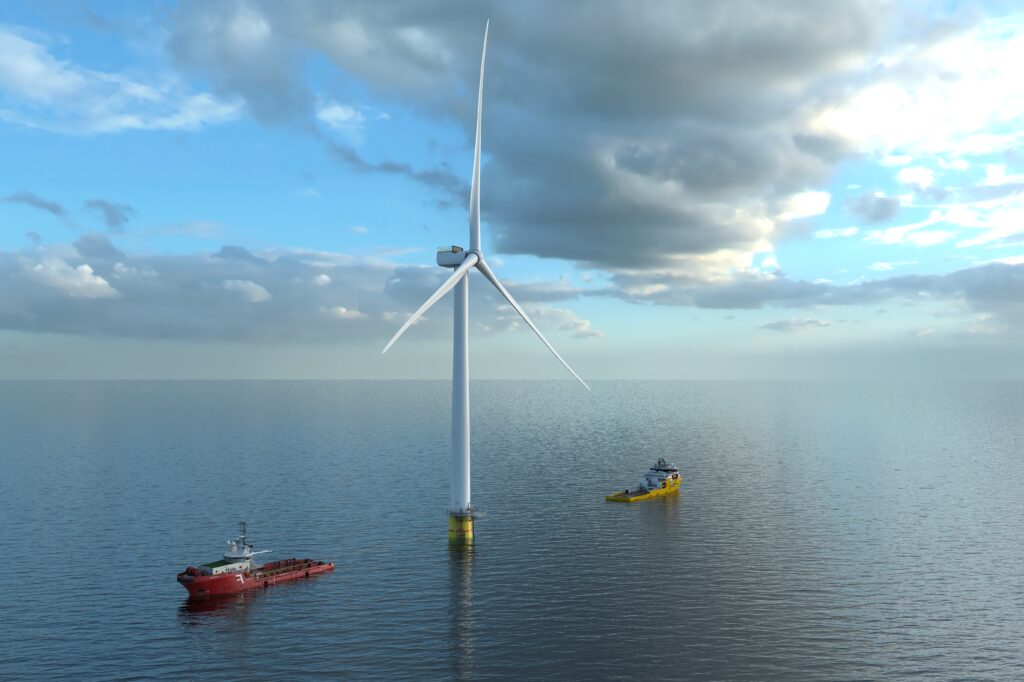
The offshore construction of Empire Wind 1 is a significant step towards innovative energy production. The project utilizes advanced techniques, hundreds of US based workers, and specialized vessels for each phase of construction. Alongside effective avoidance, minimization and mitigation strategies, and best-in-class technologies drawn from Equinor’s successful projects, the project aims to minimize its environmental impact while contributing to New York’s energy future. Empire Wind 1 is set to become a vital part of New York’s renewable energy landscape.
Below, find out more about how offshore construction works, the high-tech vessels we use, our commitment to protecting the environment, and technologies drawn from successful Equinor projects around the world. Empire Wind 1 is expected to be fully operational in 2027, and this page will be updated throughout different phases of construction.
2025 Marine Activities
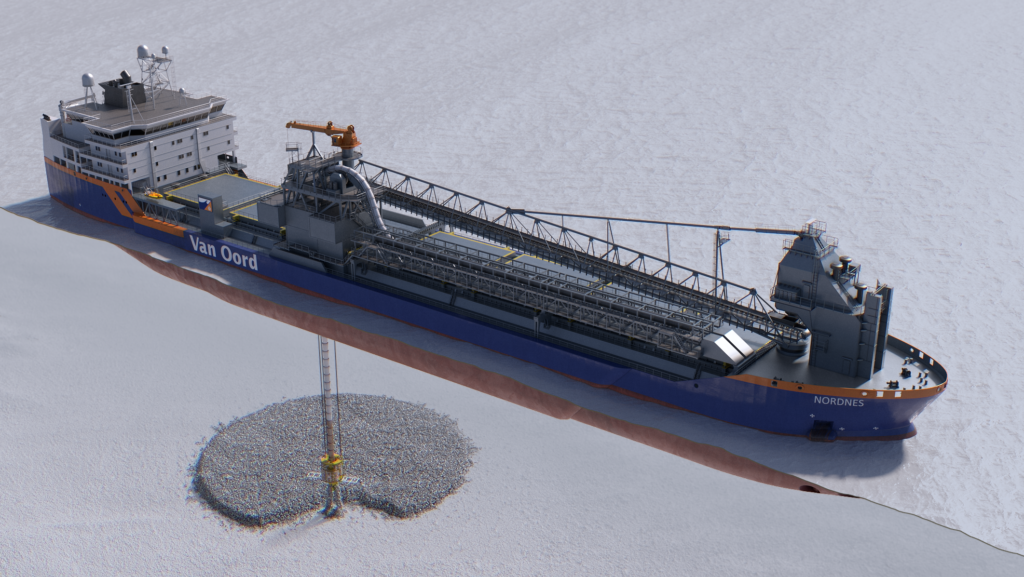
1.Rock Installation
Before foundations can be installed, rocks are placed on the seabed to create a stable base and to protect against erosion. The project will place a layer of smaller rocks before foundation installation. A second layer of larger rocks will be placed following installation.
Environmental Mitigation Strategies
Timing: Construction activities are scheduled to avoid periods of peak wildlife migration.
2. Foundation Installation

Foundations support the wind turbines and ensure they remain stable in the ocean. Monopile foundations, large cylindrical structures, will be installed into the seabed. They serve as both the foundation for the turbines and the entry point for inter-array cables that carry the electricity generated by the turbines to an offshore substation. Monopiles are particularly suited for the relatively shallower waters found in the Empire Wind lease area.
Foundations are installed using a semi-submersible crane vessel (SSCV) to lift and position the monopiles in place. During installation, the monopile is positioned within a large gripping mechanism on the SSCV, which tilts the monopile into a vertical position. With the aid of the vessel’s crane, the monopile is lifted into place, then lowered to the seabed. The monopiles are then installed into the seabed using a hydraulic hammer. Empire Wind 1 will install 54 monopile foundations.

Environmental Mitigation Strategies
Installation techniques are designed to reduce noise, protecting potential nearby marine wildlife. Seasonal restrictions and noise mitigation measures, such as bubble curtains, are employed to avoid and minimize and mitigate potential impacts to marine life.
For more in-depth overview about mitigation strategies click here.
Download a fact sheet about mitigation strategies here.

Resources
Sign up for the Empire Energizer and construction updates.
If you’d like to share a concern, please visit the Complaint and Resolution portal here.